Githurai 45, Thursday, July 9, 2026, 7:14 a.m. The smell of teargas still hangs over the junction like a dirty curtain. A mama mboga named Wambui Njeri, 38, sweeps broken glass from in front of her vegetable stall. Two crates of tomatoes — her entire day\’s inventory — lie crushed in the gutter. She did not attend any rally. She did not carry any placard. She simply opened her shop on the wrong morning. “Sisi wanjiku,” she says, not looking up, “ndiyo tunalipia siasa.” (We ordinary people are the ones who pay for politics.)
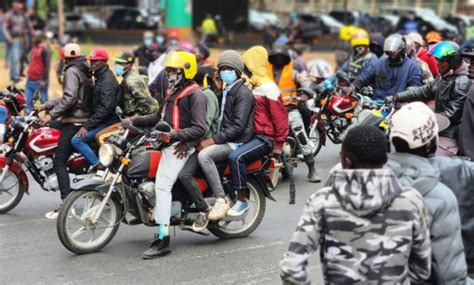
She is not wrong. Yesterday, rival political mobilisers — locally known as goons, hired muscle attached to competing 2027 parliamentary hopefuls — clashed along the Thika Superhighway corridor. Three boda boda operators were hospitalised. A matatu was stoned. The Kenya Police, according to Citizen TV\’s evening bulletin, made two arrests. Both suspects were released by noon.
This is a story about political violence. But it is really a story about money — specifically, about who funds the violence, who profits from it, and why, with Elections 2027 now just 392 days away, the machine is already warming up. The goon, in Kenyan politics, is not a spontaneous creature. He is a budget line item.
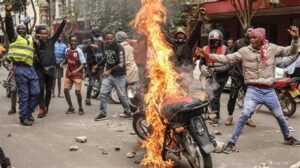
The economics are depressingly familiar. According to a 2025 post-election audit by the Kenya Human Rights Commission, cited in a follow-up investigation by The Standard, aspirants in competitive constituencies spent between Ksh 800,000 and Ksh 3.2 million on what fixer networks euphemistically call “crowd facilitation” — transport, kitu kidogo per head, and, at the violent end of the spectrum, payment for physical disruption of opponents\’ events. In 2026, those numbers are already being revised upward.
“The tragedy,” wrote activist and photographer Boniface Mwangi on his verified social media account this week, “is that the same hustler whose boda boda was burned by a political goon will still vote for the man who paid that goon. Because he has been told the other side is worse.” It is a loop that feeds itself.
The institutional architecture meant to stop this is, to put it plainly, in disarray. The IEBC remains without a substantive chairperson — a by-election environment already straining its capacity. The party structures that should discipline aspirants are fractured: ODM, once the loudest voice against political intimidation, is consumed by its own internal war. The forced removal of Edwin Sifuna as Secretary General on June 22, 2026, has left the party rudderless on grassroots discipline at precisely the moment it needs coherence. With ODM ministers John Mbadi, Wycliffe Oparanya and Opiyo Wandayi locked inside President Ruto\’s cabinet, the opposition architecture that once policed its own corners is gone.
The government\’s record is not cleaner. When the Finance Bill 2026 passed 122 votes to 40 on June 18, critics noted that at least four MPs who voted yes had faced credible accusations — documented by Nation Media — of using hired crowds to suppress opposition rallies in their constituencies in the preceding months. No charges were filed. No party disciplinary action followed.
Veteran journalist Macharia Gaitho, writing in the Nation, framed it precisely: “Goonism survives in Kenya because it is cost-effective. The perpetrators face no legal consequence, the financiers face no electoral consequence, and the victims — wanjiku — have no platform. Until that calculus changes, every election cycle will be bloodier than the last.”
The human cost accumulates quietly. The Kenya National Commission on Human Rights recorded 47 incidents of politically motivated violence between January and June 2026, a 34 percent increase over the same period in the pre-election year of 2021, according to data shared with The East African. Fourteen of those incidents occurred in constituencies already flagged as Elections 2027 hotspots by the National Cohesion and Integration Commission.
Back in Githurai 45, Wambui is still sweeping. She calculates her losses — Ksh 1,200 in tomatoes, half a day\’s trading — against the silence of every institution that should protect her. She has no M-Pesa float to absorb the shock. Her jua kali economy has no insurance. “Hii nchi,” she says finally, setting down her broom, “inaumiza watu wake.” (This country hurts its own people.)
The open question, with Elections 2027 392 days away, is whether any politician — in government or opposition — has the courage and the incentive to dismantle the machine that put them where they are. History, in this country, suggests the answer. But history, as Wambui\’s crushed tomatoes remind us, is paid for by people who never wrote it.
Leave a Reply